Nvidia on sale? The bargain trap
 Mathias Schmit
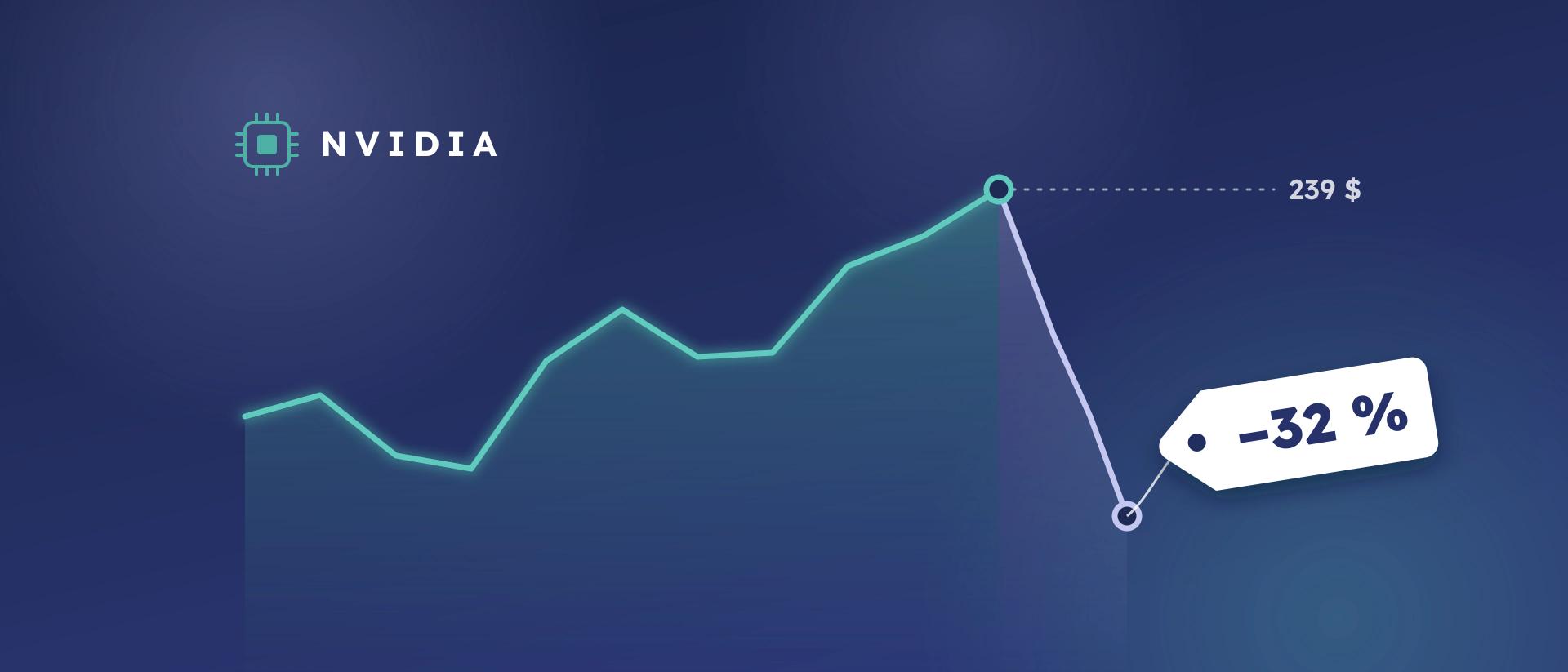
At −32 % from its record high, the stock looks cheap. That is exactly what our brain wants to believe. Behind the romance lies a business model that raises concerns. Behind the urge to buy lie well-known biases.
Ten days ago, the sell-off in artificial intelligence stocks dragged Wall Street into its worst session in more than a year, with Nvidia at the heart of the storm. Here is what came next. And it has nothing to do with chips.
A week that shook the AI giant
Over the weekend of 7 and 8 November 2026, Jensen Huang, co-founder of Nvidia and its chief executive for 33 years, acknowledged an affair with a woman described by the American press as an alleged Chinese spy. These suspicions have not been established. On Wednesday 11 November, a second affair was revealed and the board accepted his resignation. The chief financial officer, Colette Kress, is serving as interim chief executive.
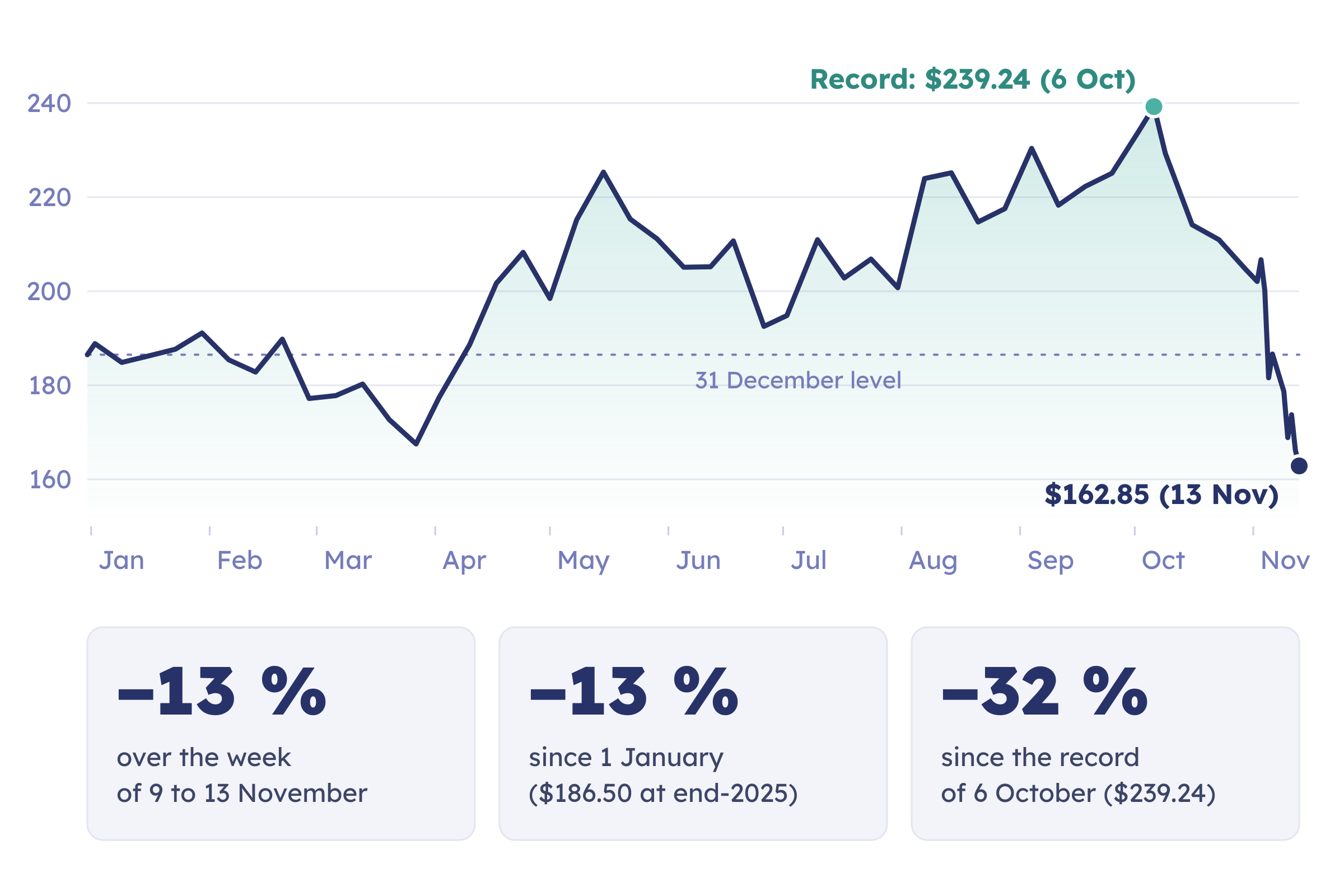
The slide had begun before the affair, with the storm over artificial intelligence stocks. Since early October, Nvidia has lost more than $1.6 trillion in market value. I will not comment on anyone’s private life. What interests me here is what this week reveals about risk.
More than a romance: a risky business model
Reducing Nvidia’s fall to a private affair would be a mistake. Above all, Jensen Huang’s departure turns the spotlight on the way Nvidia sells its chips. It no longer simply sells them: it invests in its customers, buys services from them and sometimes helps them pay.
- Shareholder in its customers. In September 2025, Nvidia announced plans to invest up to $100 billion in OpenAI, one of its largest chip buyers. The project has since been scaled back to around $30 billion, according to press reports.
- Customer of its customers. The same year, it committed to buying, until 2032, all the computing capacity that the server rental firm CoreWeave, equipped with its chips, failed to sell. Initial value of the order: $6.3 billion.
- Guarantor for its customers. In August 2026, it granted a guarantee of up to $105 billion to help OpenAI lease a huge data centre campus in Ohio, where Nvidia will be the exclusive chip supplier. The guarantee covers part of the rent and energy payments.
On 13 November, The Wall Street Journal went further. According to the newspaper, which relies on anonymous sources, Nvidia was discussing multibillion-dollar guarantees for companies that could not afford to buy its chips. In return, it proposed that capacity rental firms pay it a share of their revenue. Dozens of companies applied.
These deals were led by Jensen Huang’s son-in-law, promoted to vice-president in January. Colette Kress reportedly asked how these deals were selected, how the guarantees were assessed and how their return was calculated. She also reportedly halved the initial commitment to OpenAI before it was signed. The newspaper does not present this matter as the cause of Jensen Huang’s departure. In August, he rejected any notion of “circular financing”: “OpenAI will pay the rent”.
Three risks to watch
- Demand partly financed by the seller. Part of the sales depends on Nvidia’s ability to lend or provide guarantees. Reported growth becomes harder to read.
- A double hit in a slowdown. If demand weakens, Nvidia sells less and must also honour its guarantees.
- Cross-links. Nvidia is at once supplier, shareholder, customer or guarantor of the same companies. A problem at one of them would hit it through several channels at once.
The practice is neither illegal nor new. But it concentrates risks where investors thought they saw simple growth. On Tuesday 17 November 2026, the earnings release will be the first opportunity to learn more.
The bargain hunt
After such a fall, many see an opportunity. Caution: this is precisely when our biases work hardest. Is it a windfall? The honest answer: nobody knows. Not the analysts, and not me. Recent years show it: a spectacular fall can be the start of a recovery or the middle of a decline. And at the time, the two look alike.
Six recent falls: three with no comeback (Wirecard, Credit Suisse, Novo Nordisk), three rebounds (Nvidia, Meta, Netflix). Sources: Reuters, RTÉ, CNBC, finews, AP, CBS News, Euronews, ChartRow, Forbes, The Motley Fool, Benzinga. Details at the end of the article.
| Case | The fall | What followed |
|---|---|---|
| Wirecard (2020) | German payments flagship and DAX member. €1.9 billion missing: −97 % in one week. | Insolvency on 25 June 2020, the first ever for a DAX member. |
| Credit Suisse (2022-2023) | November 2022: the Saudi National Bank invests 1.4 billion francs, at 3.82 francs per share. | March 2023: takeover by UBS at 0.76 franc per share. A loss of around 80 % for the Saudi investor. |
| Novo Nordisk (2024-2025) | Around −54 % between its June 2024 peak and May 2025. The chief executive steps down. | End of July 2025, a new profit warning: a fall of more than 20 % in one session. |
| Nvidia (2021-2022) | Around −66 % between November 2021 and October 2022. | Back at its peak in May 2023. |
| Meta (2021-2022) | Around −77 % between its September 2021 peak and the end of 2022. | New record in January 2024. |
| Netflix (2021-2022) | Around −76 % in a few months, after a record high. | Back at its record, around $700, in summer 2024. |
Even professionals get it wrong, and in both directions. The Saudi National Bank saw an opportunity in a battered Credit Suisse: it lost around 80 % of its stake in four months. Conversely, the American investor Bill Ackman bought Netflix at around $400 in early 2022, then sold it at around $225 in April, with a loss of around $400 million. Two years later, the stock was back at around $700.
Belgian savers have known this story since Fortis. The share was worth more than 30 euros in 2007. At the end of September 2008, at 5 euros, it looked like a bargain. On 1 December, it was trading at 0.69 euro: a further 86 % loss for those who thought they had got a good deal.
The bargain bias
Why do so many investors rush into a falling stock? Three mechanisms reinforce each other.
- Anchoring. At $163, Nvidia looks “on sale”. On sale compared with $239, a price that no longer exists. Amos Tversky and Daniel Kahneman, a future Nobel laureate, showed this in 1974 with a rigged wheel of fortune. After seeing it land on 10, participants estimated the share of African countries in the UN at 25 %. After seeing it land on 65, at 45 %. An unrelated number is enough to shift our judgement.
- Attention. We buy what people are talking about. A study of 78,000 American households shows that individual investors are net buyers of stocks that are in the news. The day after a very sharp fall, they bought nearly twice as many as they sold. This week, no stock was talked about more than Nvidia.
- Survivorship bias. We remember Meta, Netflix and Nvidia in 2022: they are still here and their rebound is recounted everywhere. Wirecard and Credit Suisse have vanished from our screens and from our memories. The result: “buying the dip” always seems to win.
The data do not argue for the bargain. Among US stocks from 1963 to 2001, those furthest from their one-year high subsequently returned, on average, less than those close to it.
“A stock is never “on sale”. Its price reflects the company’s future prospects, not what it was worth yesterday.”
The right reflex: hide the old price and the headlines, then ask yourself whether you would buy this stock at this price if you had never heard of it.
Should you buy Nvidia today?
Nobody can answer that for you. But four checkpoints can help you decide.
- A fall does not make a bargain. Today’s price reflects what the market expects of the company’s prospects. It is not to be compared with the price six weeks ago.
- Opinions differ. D.A. Davidson maintains its buy rating but cuts its price target from $300 to $200. Oppenheimer believes that, in the short term, fundamentals will take a back seat.
- The coming days matter. Nvidia publishes its quarterly results on Tuesday 17 November. And the board is still looking for a permanent chief executive.
- The specific risk remains intact. Buying today means betting on a company, on its succession, on its financing model and on a sector.
So the real question is not “should I buy?” but “what place can this stock take in my portfolio without putting it at risk?”. If you invest through a broad fund, you already own some. If you are considering buying it directly, set in advance the maximum share, your horizon and what you will do if the price falls a further 20 %.
This text is educational. It is neither a recommendation to buy nor a recommendation to sell.
Three questions to ask yourself
- What share of my savings depends on a single company? Shares held directly, shares in your employer, concentrated funds: add it all up.
- Is my “world” fund as diversified as its name suggests? Look at the weight of its top ten holdings. This is public information, often on the fund’s factsheet.
- Would my decision hold if the leader I admire left tomorrow? If the answer is no, it is no longer an investment, it is a bet on a person.
Further reading
Meeting your banker or adviser soon?
Our guide “Before signing an investment” helps you prepare for that meeting: 14 questions to ask and the figures to judge the answers. It is free.
Download the guideSources
- The facts. TechCrunch, “Nvidia’s Jensen Huang resigns, chipmaker names CFO Colette Kress as interim CEO” (12 November 2026); CNBC, republished by CNBC Africa (13 November 2026), for the 33 years at the helm of Nvidia, the lost market value, the run of weekly declines and the analysts’ views.
- Share price. Closing prices from 6 to 13 November 2026: StockAnalysis (S&P Global Market Intelligence). Record of 6 October 2026: ChartRow and StockAnalysis. Change since 1 January and chart for the year: closing price on 31 December 2025 ($186.50) and for January, FinancialContent; month-ends from February to August, Digrin; September to November, StockAnalysis; Sagora calculations. Results date: Nvidia press release (28 October 2026).
- Business model. OpenAI: Data Center Frontier (24 September 2025 and 2 February 2026) and eWeek, citing the Financial Times (20 February 2026). CoreWeave: Form 8-K filed with the SEC (September 2025) and Reuters (15 September 2025). Ohio: Nvidia press release, Reuters and Axios (17 August 2026), Jensen Huang’s statement reported by Axios. A. Gardizy and R. Whelan, “Before His Ouster, Jensen Huang Belittled the Executive Replacing Him”, The Wall Street Journal (13 November 2026).
- Six recent falls. Wirecard: Reuters via Al Jazeera, RTÉ and The Next Web (25 June 2020). Credit Suisse: CNBC via NBC (20 March 2023); finews (20 March 2023). Novo Nordisk: AP (16 May 2025); CBS News and Euronews (29 July 2025). Meta: Forbes (19 January 2024). Netflix: The Motley Fool (4 February 2024); Benzinga (2024), including Bill Ackman’s position. Nvidia 2021 to 2023: ChartRow.
- Fortis. Squire Patton Boggs, “Le scandale Fortis, une histoire belge” (January 2009); G. de Hemptinne, The Low Countries, no. 17 (2009), for the share price on 1 December 2008; Sagora calculation.
- Biases. A. Tversky and D. Kahneman, “Judgment under Uncertainty: Heuristics and Biases”, Science, vol. 185, no. 4157, 1974, pp. 1124–1131; B. Barber and T. Odean, “All That Glitters”, Review of Financial Studies, vol. 21, no. 2, 2008, pp. 785–818; T. J. George and C.-Y. Hwang, “The 52-Week High and Momentum Investing”, Journal of Finance, vol. 59, no. 5, 2004, pp. 2145–2176.
A first version of this text appeared on 15 November 2026 in L’envers des chiffres, Mathias Schmit’s newsletter on LinkedIn.
Sagora, editorial line. Educational stance: neither personalised investment advice nor an incentive to invest in any specific asset or product. Prices and information as at 15 November 2026, based on sources believed to be reliable at that date and subject to change. Past performance is not a reliable indicator of future results.
Related articles

The stock market crash of 5 August 2024: a cold autopsy
A spectacular market crash, fuelled by disappointing economic indicators, geopolitical tensions and worrying signals around players such as Apple Inc. and Warren Buffett, shook the whole of the global economy.

A formidable animal, yet too rarely feared: the Black Swan
“Black swans”, popularised by Nassim Nicholas Taleb, are unpredictable events with major consequences, at once fascinating and feared by investors.

The man at the top of the Ponzi pyramid
The Bernard Madoff affair shows that, despite the rules, even financial systems can be manipulated by frauds such as the Ponzi pyramid.