The superiority of equities over the long term
“In the stock market, the distant future is easier to predict than the near future” (Robert Shiller, Nobel laureate in economics 2013)
To illustrate this point, let us take three types of asset: government bills, 10-year government bonds and a portfolio of equities from an index fund such as the S&P 500.
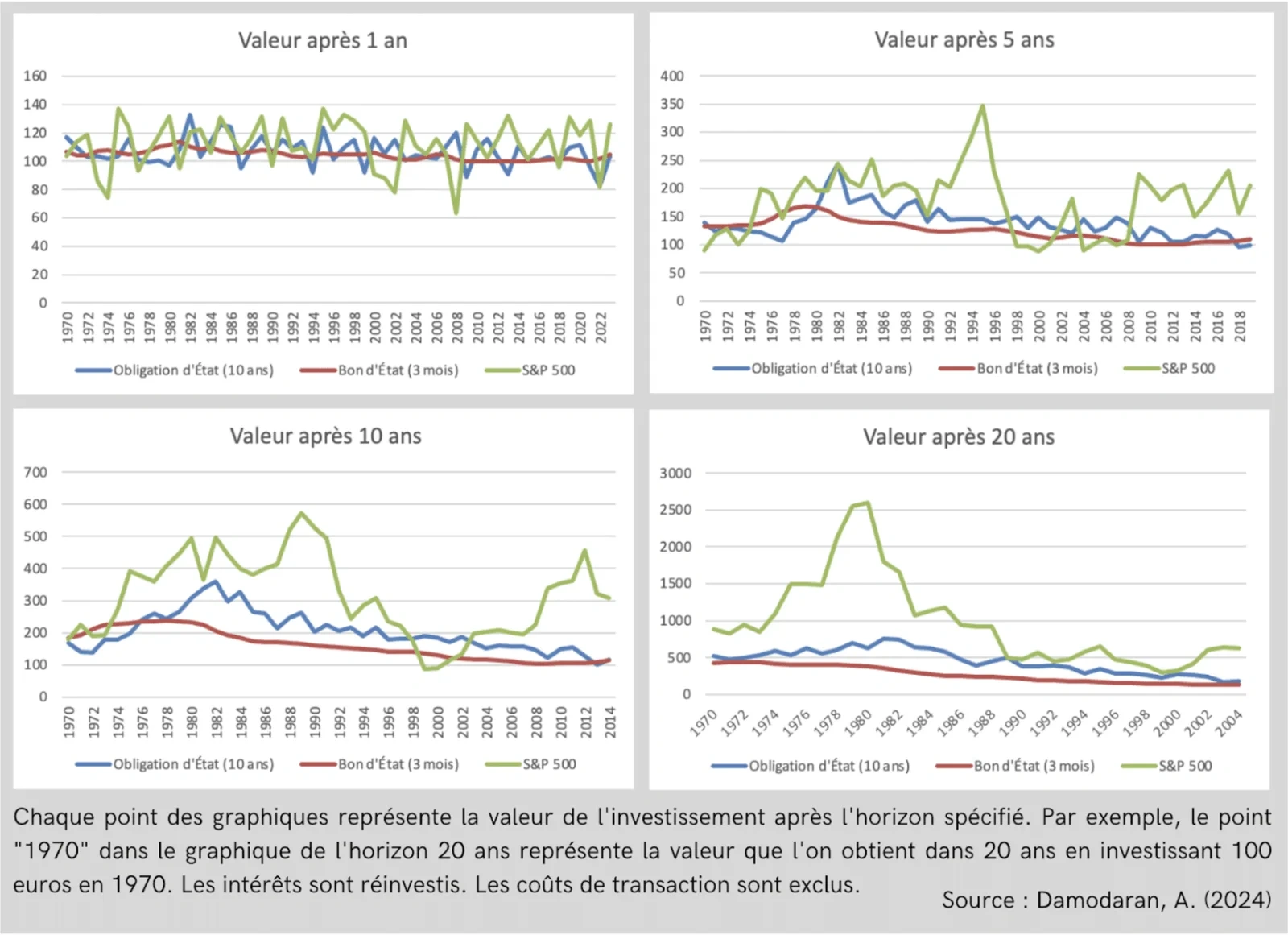
Let us invest 100 euros in each of these assets and analyse the results over different time horizons (Figure 1). Over five years, the horizon value of the 100 euros invested in an index fund such as the S&P 500 fluctuates far more and may at times even be worth less than that of the 100 euros invested in government bonds or bills, owing to the greater volatility of equities. This phenomenon also occurs over the 10 and 15-year horizons, although less frequently as the investment period lengthens. Over 20 years, by contrast, the horizon value of our 100 euros invested in equities systematically outperforms the value of those invested in government bills and bonds, thereby illustrating the long-term superiority of diversified equity portfolios such as the S&P 500 in terms of return, despite their initial volatility.
The gains from equities are therefore clearly higher over the long term, with a few exceptions. For example, in 1989, an investment of 100 euros over a 20-year horizon returned “only” 500 euros, a return similar to that of a government bond. This “anomaly” is explained by the bursting of the internet bubble in 2000, after a period of strong economic growth marked by the technological boom of the 1990s. Then by the fall in rates when the stock market collapsed in October 2008, a consequence of the financial crisis triggered by the bankruptcy of Lehman Brothers in September of the same year. These successions of crises, although rare, are significant. This is why temporal diversification is crucially important, in order to smooth out these risks of successive crises and to benefit from diversified market conditions.
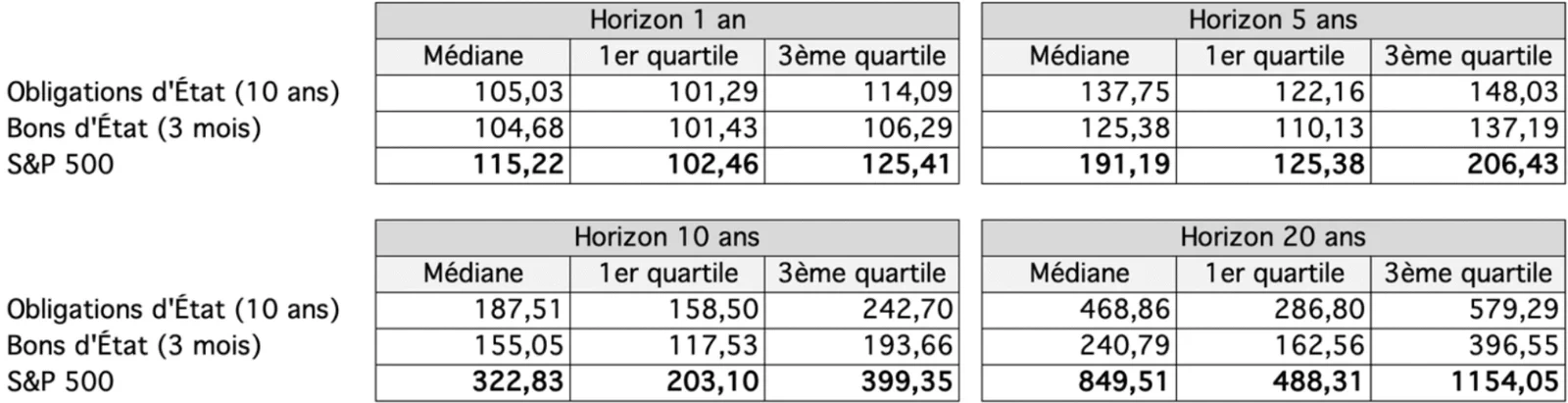
The superiority of equities is also observed in their median return, always higher than that of government bonds and bills, whatever the horizon (Table 1).
Figure 1 – Charts showing the value of 100 euros invested over different horizons in 3 types of asset, on a historical basis between 1970 and 2023
Table 1 – Statistical summaries of the data in euros for horizons of 1 to 20 years, on a historical basis between 1970 and 2023
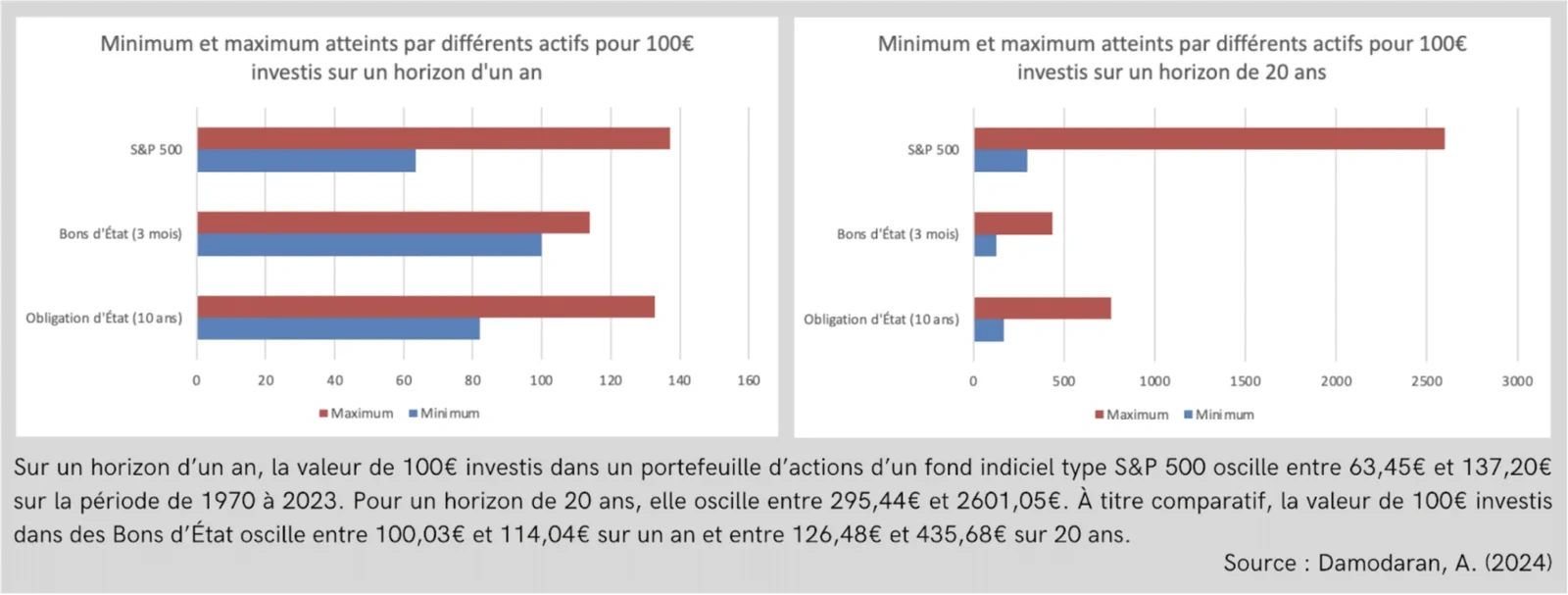
Unfortunately, we cannot have our cake and eat it. As we have already mentioned, equities are subject to the substantial volatility of the markets. In the short term, they therefore present a minimum return lower than that of safer assets. Their maximum return, however, is clearly higher. Moreover, over the long term, even the minimum return on equities outperforms that of government bills and bonds (Figure 2).
Be careful, however: the minimum and the maximum are not very robust to extreme values and must therefore be interpreted with caution. We have deliberately used them because extreme events must not be ignored, but for a more faithful representation of the trend in the data, it is preferable to opt for quartiles, which are less sensitive to outliers. Never limit your analysis to a single measure, but use it in conjunction with other indicators to obtain the best possible representation of reality.
Figure 2 – Charts showing the minimum and maximum values of 100 euros invested over horizons of 1 and 20 years for 3 different types of asset, on a historical basis between 1970 and 2023
Conclusion
“All things come to those who wait” (Clément Marot)
In conclusion, investing in an equity portfolio makes it possible, over the long term, to obtain substantially higher returns than government bonds and bills, despite the strong volatility of the markets. One should therefore not always flee from risky assets, provided that the underlying risks are tamed by rigorously applying the principles of asset diversification and temporal diversification. In short, do not be afraid to add a little spice to your finances, as long as you know how to balance the flavours!
Would you like to navigate the turbulent waters of the financial markets more serenely? Do not hesitate to visit our website to discover our portfolio management training programme!
#FinancialTraining #PortfolioManagement #PersonalFinance #Diversification #KnokkeSummerSchool
Sources
Damodaran,A. (2024). Historical Returns on Stocks, Bonds and Bills: 1928-2023. https://pages.stern.nyu.edu/~adamodar/NewHomePage/datafile/histretSP.html
Dehon, C. (2024). Introduction aux techniques statistiques robustes [Slides].
Tretina, K. (2023, August 9). What is the S&P 500? How does it work? Forbes. https://www.forbes.com/advisor/investing/what-is-sp-500/