
A formidable animal, yet too rarely feared: the Black Swan
“Black swans”, popularised by Nassim Nicholas Taleb, are unpredictable events with major consequences, at once fascinating and feared by investors.
The origins of the black swan
Born from the pen of the Latin poet Juvenal, the expression “black swans” was used for the first time in his poem Satire VI. In it, he compares the rarity of the ideal woman, endowed with many qualities, to that of a bird with black plumage. Behind this analogy, which may raise a smile, lies a far more alarming observation: the fragility of the human system of thought.
Indeed, at that time, the black swan was seen as a chimera, an impossible event, even in the most fertile imagination. And yet, in 1697, the Dutch explorer Willem discovered one, on the still-unknown soil of Australia, calling into question the until-then unshaken view of Europeans, according to which a swan could only be white. The black swan theory therefore shows us that a single event, a single occurrence, can be enough to demolish hypotheses and logical constructions built up over time. “Just because you have never seen a black swan does not mean it does not exist.” An excuse to be used wisely, of course.
The lessons of Nassim Taleb
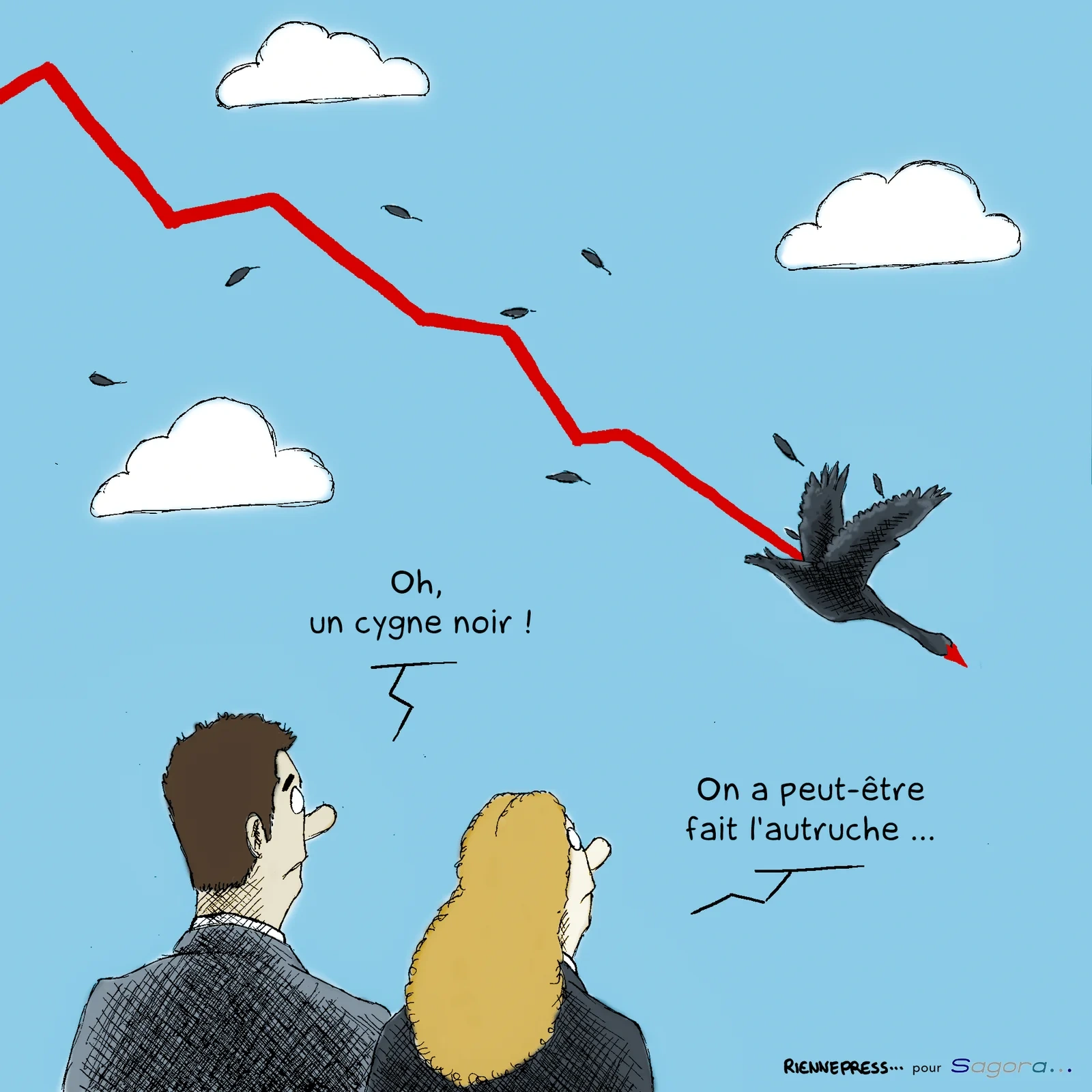
It is to Nassim Nicholas Taleb, eminent professor of economics and writer, that we owe the spotlight on the concept of the Black Swan in the financial markets, to denounce the under-valuation of rare events, both in terms of occurrence and of price.
In his book entitled “The Black Swan: The Impact of the Highly Improbable”, he sets out the existence of unpredictable, low-probability events, called black swans, which, if they occur, have considerable repercussions. In this article, we will look at three essential aspects of his theory: the discord between Gauss and Black Swans, the imperfections of the human brain, as well as the possibility of taming unpredictable phenomena.
Beware of the Gaussian curve
The reputation of the star of statistics is well established. With its iconic bell curve, the Gaussian describes the symmetrical distribution of data around the mean. The idea is simple: the closer an observation is to the mean, the higher the probability that it will occur. Conversely, the further it moves towards the tails of the curve, the rarer the observation becomes.
With all the respect we owe to Gauss's model, which has proved useful in many situations, if we listened to it to predict extreme events, the stock market crash of October 1987 should only occur once every 1017 years! And yet, among the extreme events of recent years, we can cite: the Crash of 1929, the bursting of the internet bubble in 2000, the attacks of 11 September 2001, the global financial crisis of 2007-2008, the Fukushima nuclear disaster in 2011, the COVID-19 pandemic, and so on.
The Gaussian and the stock markets
Another way to illustrate the limits of Gauss's model is to look at the daily returns of the Dow Jones index from 1928 to 2009. Indeed, the normal distribution tells us that extreme events, defined here as positive or negative daily returns of more than 6%, should only occur one day in a million. In reality, we are closer to 2500 days in a million, that is, not far off one day a year. So, unless we are using different calendars, these events occur far more frequently than the bell curve suggests.
To rely on the Gaussian curve is therefore to WRONGLY consider extreme events to be rare. In the context of the stock market, this can have devastating consequences, as the many systemic crises bear witness.
The example of Lehman Brothers
Take the example of Lehman Brothers. The bankruptcy of this American bank in 2008 had completely escaped the radar of a good many investors. And yet, several warning lights were on red: excessive exposure to the American mortgage markets, financial products spreading risks across the world, a commercial strategy founded on high leverage with a low level of equity, and more besides. Carried along by the prevailing optimism, investors and regulators ignored these indicators and paid the price.
Human laziness in the face of Black Swans
Indeed, the human mind also has its share of flaws, and this is nothing new. Lazy by nature, our brain uses many shortcuts, making it vulnerable to cognitive biases. We feel an aversion to uncertainty, and so we look for explanations to all phenomena, trying to confirm them by every possible means.
The cognitive bias of the Black Swan is merely an optical illusion that enjoys deceiving our brain. We interpret visual information on the basis of our past experiences, and fill our gaps by relying on pre-existing patterns. And yet, what a surprise when the focus is adjusted and the picture finally reveals itself to us! So... keep your eyes open!
Learning to tame black swans
We cannot escape the improbable. Unfortunately, we have no hold over the black swans that pursue us at the edge of the lake. But fortunately, we are endowed with a brain, two arms and two legs that we can control, in order, for example, to throw a piece of bread to the enraged bird, or to jump behind a barrier to protect ourselves from it. Extreme events have always existed and will continue to exist, so we might as well learn to tame them.
Diversifying your assets: one of the ways to limit the damage in the event of extreme events
As an investor, diversifying the assets in your portfolio is a good example of a strategy for adjusting to Black Swans. As the saying goes, “do not put all your eggs in one basket”. If the black swans end up catching up with us, we might as well be able to show them that the eggs we are holding do not all come from their nest, but also from that of the neighbour's hen, the orchard's swallow, and so on, in order to spare ourselves a good deal of trouble.
Time diversification: an indispensable strategy
Besides asset diversification, time diversification is also indispensable for coping with extreme events. It consists in preferring to spread one's investment over a given period, rather than staking everything at a specific moment.
By spreading one's investment over time, one reduces the risk associated with market timing. Let us imagine that you have a tidy sum of 60,000 euros to invest. Instead of investing the whole of this sum today, you decide to allocate 5000 euros per month over a period of one year. In this way, if an extreme event occurs after only two months, you will incur losses “only” on a part of your investments, that is, 10,000 euros.
Thus, time diversification allows you to mitigate the potential impact of extreme events on your portfolio. Simply by spreading your investments strategically over time.
Conclusion: how to tame black swans to succeed in the financial markets?
Black Swans are not an inevitability in themselves. Rather, they represent an opportunity to test our resilience in the face of adversity and sometimes even to take advantage of serendipity. Indeed, so far, we have only addressed their negative aspects, but the latter can also have positive repercussions. It is therefore essential to understand how to take advantage of them while guarding against harmful events.
For this, Taleb offers us a series of valuable pieces of advice:
-> stay attentive to unexpected events.
-> adopt a flexible attitude in your beliefs and your thinking.
-> challenge your hypotheses and look beyond the obvious.
In short, arrange to place yourself in situations where the positive consequences are much greater than the negative ones.
But the most important of all: recognise the limits of knowledge and constantly question received ideas. This is precisely the approach that we will strive to pursue through our weekly articles!
Key points to remember about black swans according to Nassim Taleb
-> Black swans are unpredictable, low-probability events. Their repercussions are considerable but, in hindsight, they seem inevitable to us.
-> Extreme events are not rare and the Gaussian curve is not a good tool for measuring them.
-> The human system of thought is fragile and subject to many biases.
-> We cannot control extreme events. But we can control the way in which we react to them, through both asset diversification and time diversification. As an investor, you have many tools to adjust to Black Swans.
-> It is possible to take advantage of positive Black Swans. Keep your eyes open, stay flexible and embrace these opportunities.
Would you like to navigate the choppy waters of the financial markets more serenely? Do not hesitate to visit our website to discover our portfolio management training programme!
#FinancialTraining #PortfolioManagement #PersonalFinance #Diversification #KnokkeSummerSchool
Sources
Juvenal, Satire VI, translation by V. Raoul. (1812). https://remacle.org/bloodwolf/satire/juvenal/satire6a.htm
Raikar, S. P. (2023, 3 February). Black swan event | Definition, History, Examples, & Facts. Encyclopedia Britannica. https://www.britannica.com/topic/black-swan-event
Schmit, M. (2023). Banking and Asset Management. Understanding Banking Performance [Slides].
Wiggins, R. Z., Piontek, T., & Metrick, A. (2014). The Lehman Brothers Bankruptcy A: Overview. Social Science Research Network. https://doi.org/10.2139/ssrn.2588531
Related articles

The stock market crash of 5 August 2024: a cold autopsy
A spectacular market crash, fuelled by disappointing economic indicators, geopolitical tensions and worrying signals around players such as Apple Inc. and Warren Buffett, shook the whole of the global economy.

The man at the top of the Ponzi pyramid
The Bernard Madoff affair shows that, despite the rules, even financial systems can be manipulated by frauds such as the Ponzi pyramid.

Portfolio management and market volatility
Investment results fluctuate: they make you neither a genius nor an incompetent.