
The man at the top of the Ponzi pyramid
The Bernard Madoff affair shows that, despite the rules, even financial systems can be manipulated by frauds such as the Ponzi pyramid.
Who was Bernard Madoff?
The illustrious Bernard Madoff, “Uncle Bernie” to those close to him, was a respected man in the United States in the 1990s and embodied the famous American dream. From lifeguard at Long Island to chairman of the NASDAQ stock market (an exchange focused on technology companies), his journey impressed by its audacity and ambition. The businessman was also known for his boundless generosity, through his many donations to associations and his active involvement in charitable and cultural works.
In short, Madoff was the icon of his time, a snake charmer who seemed able to manipulate the markets like no one else. All the stars were therefore aligned for him to enjoy the blind trust of his contemporaries, ready to entrust him with their savings to see the magic happen.
The beginnings of Madoff's fraud
And this, B. Madoff himself had understood very well. Carried by the surrounding laxity of a market that had been rising since the 1980s, his web was quickly woven and spread. It all began when the broker left NASDAQ to create his own investment funds, the most emblematic of which was “Bernard Madoff Investment Securities”.
The idea was simple. B. Madoff infiltrated upmarket circles, such as the many country clubs of Palm Beach, and humbly praised the merits of his funds. The financier even had the nerve to feign reluctance, granting access to his incredible funds only in return for a long period of courtship on the part of his victims.
Indeed, the Madoff fund was reserved for the elite because it boasted of delivering steady returns of around ten per cent a year! A question then arises: how was it possible to promise a constant high return, whatever the market conditions? Perhaps it was the Madoff magic at work.
Unfortunately, magic only exists in our favourite Disney films, and the success of the Madoff fund in fact rested on a well-known fraudulent scheme: the Ponzi system.
Understanding the Ponzi system with Uncle Séraphin
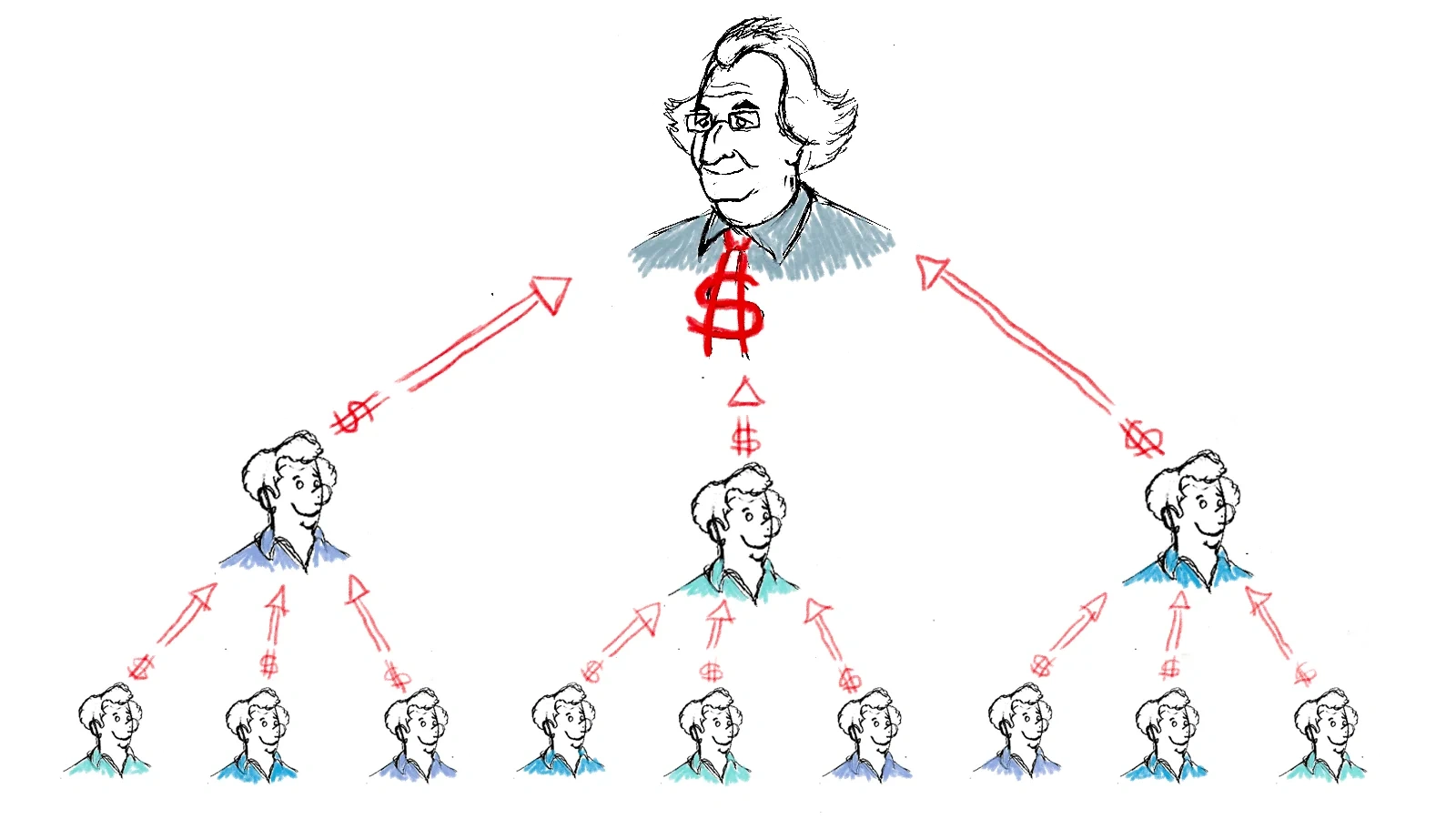
To understand properly, let us plunge back into the adventures of Aunt Agathe and Uncle Séraphin. Remember, we had left them in our last article on market volatility, where we had learned the importance of diversification, both in terms of assets and over time, for portfolio management.
To understand properly, let us plunge back into the adventures of Aunt Agathe and Uncle Séraphin. Remember, we had left them in our last article on market volatility, where we had learned the importance of diversification, both in terms of assets and over time, for portfolio management.
Uncle Séraphin gets caught in B. Madoff's web
In 2006, Uncle Séraphin decided to spend a year in the United States to try his hand at the American dream. There, he met Madoff, who promised him an annual return of 10% in exchange for an investment of 200,000€. Sensing a golden opportunity, that old fox Uncle Séraphin invested the required amount in the Madoff fund. During the evening, he was joined by 9 other people, allowing Madoff to end up with a total of 2,000,000€ in his pocket.
The collapse of the mirage: the fall of B. Madoff
After a year, our finance “experts” each thought they had made 20,000€. Proud of himself, but having to return home to rejoin Aunt Agathe, Uncle Séraphin claimed his 220,000€ from Madoff. But in 2008, in the midst of the crisis, Uncle Séraphin discovered to his horror that he would never see the colour of his money again.
The workings of the Ponzi system
In reality, Uncle Bernie invested only a fraction of the capital received from his victims, using the rest to finance the returns promised to earlier investors. This is therefore a classic Ponzi scheme, where the money of some pays the return of others, without any creation of real value.
Such a scheme can go unnoticed as long as the money is claimed in dribs and drabs, and this was the case for the Madoff arrangement. However, in the event of a collapse of the financial markets as in 2008, it is impossible to repay all the investors.
The ignored clues of B. Madoff's fraud
Uncle Séraphin is far from being the only one to have been fooled by Bernie, and for good reason: some intermediary funds, which gave access to the Madoff fund, were regulated funds supposed to protect investors. This therefore contributed, in addition to Madoff's charm, to the climate of trust in which the investors found themselves. One example of these consequences is LuxAlpha, which saw its investors claim almost 762 million dollars in damages following their involvement in Madoff's Ponzi scheme.
Yet several elements should have alerted savvy investors. First of all, when one looks at the prospectus of one of the regulated sub-funds of the Madoff fund, one can observe a chart showing the fund's returns over time. This chart presents an almost straight line, meaning that the returns are constant, with very (too) small fluctuations.
Yet, if you remember our article on market volatility, the analysis of the returns of the S&P 500 stock index had shown us that even a well-diversified portfolio promised annual returns that could vary between -30% and +50%. As the fund's objective was to replicate a similar index, the chart should have presented far greater volatility.
Then, it emerged that Madoff combined several functions within this regulated fund. Indeed, he acted both as asset manager and as custodian, responsible for protecting the assets. This goes against the rules governing regulated funds in Europe. You can understand that combining these two functions could awaken temptations to make off with the investors' assets.
Conclusion
We could still go through a myriad of warning signals. H. Markopolos, who specialised in detecting accounting and financial fraud, had listed 29 of them, all reported to the Securities & Exchange Commission, the financial regulatory authorities (without much success). However, the examples given are enough to prove that any good investor must keep their eyes open. Many signals are easily spotted by showing a minimum of attention.
Moreover, the sad story of Uncle Séraphin reminds us of one of the foundations of good portfolio management: asset diversification. Indeed, in his misfortune, he had the intelligence to invest only part of his capital in the Madoff fund.
Finally, a simple rule to remember is that, if you do not understand an investment strategy at first sight, find out from qualified people before investing, or use the available resources, while always exercising critical thinking!
Key points to remember
-> Financial markets are highly volatile.
-> Even well-diversified portfolios are highly risky. A linear path in the returns of a fund seeking to replicate a stock index such as the S&P 500 is therefore unrealistic. Such a path would suggest constant returns without any fluctuation, which does not correspond to the reality of the financial market, where volatility is an essential component.
-> There is no profitability without volatility, and this is true even for a diversified portfolio.
-> The fact that an investment fund is regulated should not cloud your critical thinking.
-> Diversification of assets, as well as over time, makes it possible to reduce exposure to risk.
-> In case of doubt regarding an investment strategy, stay vigilant and seek reliable information, such as quality training like the portfolio management training programme offered by Sagora!
Would you like to navigate the turbulent waters of the financial markets more serenely? Do not hesitate to visit our website to discover our portfolio management training programme!
Sources
Aït-Kacimi, N. (2021, 14 April). L’escroc Bernard Madoff est décédé en Prison. Les Echos. Accessed on 24 April 2024 at https://www.lesechos.fr/finance-marches/marches-financiers/age-de-83-ans-bernard-madoff-est-decede-en-prison-1306903
Britannica, T. Editors of Encyclopaedia (2024, May 2). Bernie Madoff. Encyclopedia Britannica. https://www.britannica.com/biography/Bernie-Madoff
de Gasquet, P. (2009, 7 January). Les rouages du “système” Madoff mis à nu. Les Echos. Accessed on 24 April 2024 at https://www.lesechos.fr/2009/01/les-rouages-du-systeme-madoff-mis-a-nu-1081132
Le Monde. (2008, 20 December). Comprendre l’affaire Madoff. Le Monde. Accessed on 24 April 2024 at https://www.lemonde.fr/economie/article/2008/12/19/comprendre-l-affaire-madoff11333543234.html
Mamou, Y.. (2009, 9 February). Les victimes du scandale Madoff mettent en cause les cabinets d’audit. Le Monde. Accessed on 6 May 2024 at https://www.lemonde.fr/la-crise-financiere/article/2009/02/09/les-victimes-du-scandale-madoff-mettent-en-cause-les-cabinets-d-audit11527611101386.html
Markopolos, H. (2005, November 7). The World Largest Hedge Fund is a Fraud. https://math.nyu.edu/~avellane/madoffmarkopoulos.pdf
Samois, O. (2021, 14 April). Décès de Bernard Madoff, le Ponzi du XXIe siècle. L’Echo. Accessed on 24 April 2024 at https://www.lecho.be/entreprises/services-financiers-assurances/deces-de-bernard-madoff-le-ponzi-du-xxi-siecle/10298083.html
Schmit, M. (2023). Banking and Asset Management. Understanding Banking Performance [Slides].
Related articles

The stock market crash of 5 August 2024: a cold autopsy
A spectacular market crash, fuelled by disappointing economic indicators, geopolitical tensions and worrying signals around players such as Apple Inc. and Warren Buffett, shook the whole of the global economy.

A formidable animal, yet too rarely feared: the Black Swan
“Black swans”, popularised by Nassim Nicholas Taleb, are unpredictable events with major consequences, at once fascinating and feared by investors.

Portfolio management and market volatility
Investment results fluctuate: they make you neither a genius nor an incompetent.