Putting the objectives and tax strategy of government bonds back into context
Before judging whether they constituted a good investment, it is worth recognising that this initiative was perceived as a response to a very real problem: the lack of profitability of savings accounts.
However, the question of the tax advantage granted to these government bonds raised criticism. Some observers judged this tax reduction to be inequitable compared with borrowers obliged to withhold a 30% withholding tax. At the time, many Belgian banks had moreover spoken of genuine unfair competition.
A legitimate question arises: would this tax advantage not have been more useful if it had been directed towards innovative companies likely to stimulate the national economy, rather than supporting a passive investment falling directly into the State's coffers?
Has the stated objective of government bonds been achieved?
As we have already said, the issuance of these government bonds was mainly aimed at boosting banking competition, by forcing Belgian banks to raise the rates of their savings accounts, which often stagnate around 1%.
Unfortunately, this objective does not seem to have been achieved. The banks did not increase savings rates, but they are nevertheless preparing to catch investors' funds on the fly at the moment the government bonds mature, by offering alternatives such as term accounts, savings certificates or life insurance policies. These offers are often limited to the funds coming from the government bonds, thus belonging more to marketing strategy than to a step towards the client.
Government bonds: a good plan for investors?
But then, were the government bonds of September 2023 really a good investment opportunity? To answer this question, let us examine two investor profiles: Uncle Séraphin and Aunt Agathe.
Practical case: Uncle Séraphin vs Aunt Agathe
On 4 September 2023, Uncle Séraphin invests 20,000 € in the one-year government bonds, attracted by the safety of this investment and by the simplicity of the process. For her part, Aunt Agathe, more financially savvy and a touch bolder, chooses to place the same sum in an ETF replicating the S&P 500. (It is important to note that the single investment of 20,000 € was chosen to simplify the example. Let us remember that time diversification remains a key strategy in investments). At the end of the year, the time of reckoning had come.
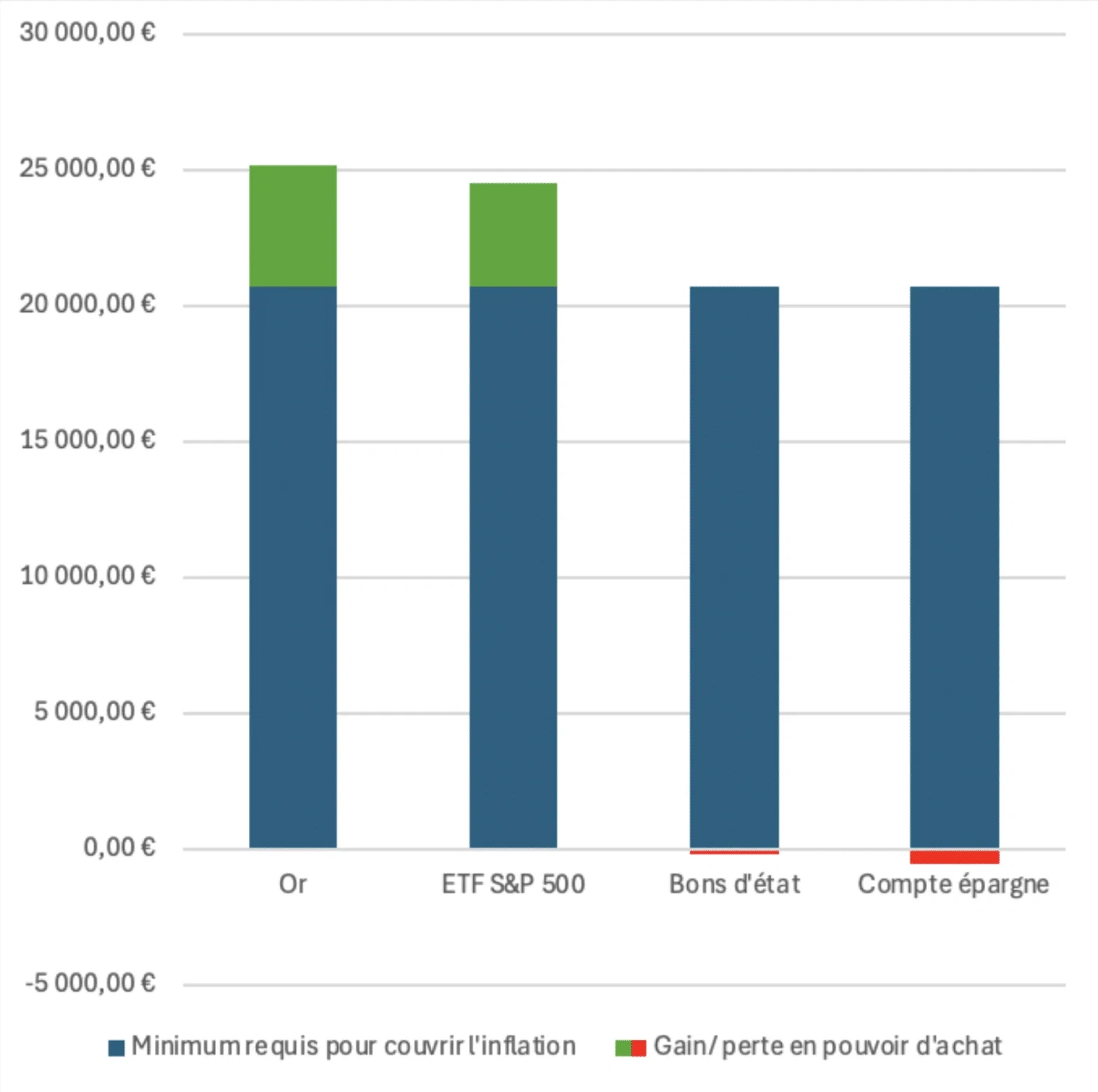
As shown in Graph 1, Uncle Séraphin, despite his initial hopes, discovers that he has not managed to beat inflation, but he consoles himself by noting that his losses are limited to 150 €. This is certainly a markedly better result than if he had left his money lying dormant in a Belgian savings account, where inflation would have eaten away more than 550 €.
Aunt Agathe, for her part, recorded a fine capital gain of 3,778€, counting only the transaction costs and the impact of inflation (because, remember, capital gains are exempt from tax, provided they can be considered as forming part of the normal management of a private estate) thanks to the robust performance of the financial markets in 2023. Her choice to invest in an ETF replicating the S&P 500 index proved judicious, allowing her not only to preserve her capital but also to grow it.
Government bonds: a good plan for investors?
Can we conclude, for all that, that Uncle Séraphin was had? Certainly, he missed the substantial returns offered by the financial markets and gold this year, but he took account of his risk-averse investor profile. All the more so as it is important to put returns back into context.
Indeed, the financial market and gold broke all records this year, but let us not forget that the annual performances of these assets are historically volatile. For example, if Aunt Agathe had invested her 20,000 € in an S&P 500 ETF at the start of 2022 over a one-year horizon, she would have recorded a loss of more than 600€.
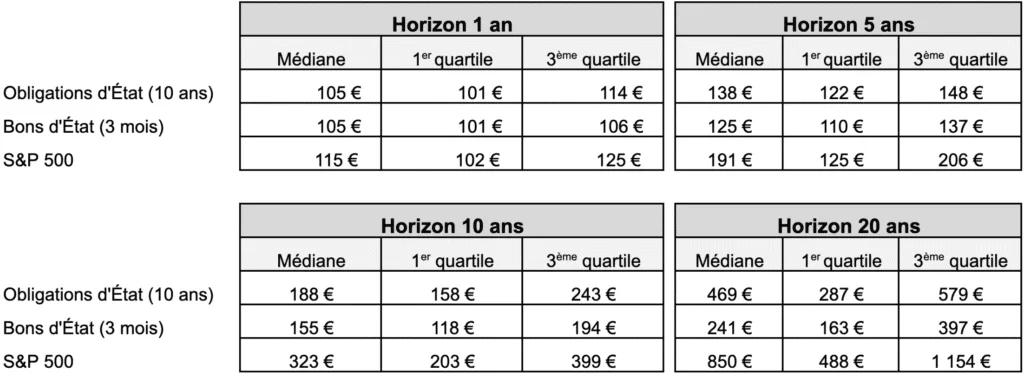
However, if he took the trouble to seek advice from experts or to educate himself in finance, Uncle Séraphin would discover that funds replicating stock market indices are not to be shunned. Indeed, in the long term, they post an average annual return of around 10%. Although it is crucial to remain aware of their volatility, the latter can be mitigated by an effective diversification of assets and an appropriate management over time.
You only have to take a look at Table 1 to realise it: over the long term, a diversified portfolio (mimicking the S&P 500) offers returns far higher than those of bonds and government bonds, and volatility can be kept under control. Be careful, the quartiles are far from excluding extreme events, hence the importance of applying a good time diversification with regular investments.
What about the new government bonds?
The supposed safety of government bonds may suit those who favour stability, but the results are disappointing as they do not even beat inflation. A diversified approach, supported by sound financial advice or personal training, can offer more attractive returns while balancing the risks. By wanting too much safety, one can miss fine opportunities for growth.
At a time when the new government bonds are proving less attractive with a net rate of 1.93% and when the banks are bringing many products back out of the broom cupboard, reflection on one's investment strategy becomes all the more pertinent. This context could well be the ideal moment to embark on training and to seek sound advice in order to manage one's portfolio more effectively !
Sources
Federal Debt Agency. Issuance of the new government bonds on 16 September 2024. Consulted on 2 September at the following address: https://www.debtagency.be/nl/node/5580#:~:text=Le%20mercredi%204%20septembre%202024,%25)%20sur%20les%20comptes%20indiqués.
BullionByPost. Gold price per gram 7 days in EUR. Consulted on 2 September at the following address: https://www.bullionbypost.fr/cours-de-lor/cours-de-lor-par-gramme/?gclid=Cj0KCQjwiuC2BhDSARIsALOVfBKHzA2HYefgp3ORgwwZBWp4LMHxtcNKmks3mRGndiS0xDTZLY0vxjQaAn0uEALwwcB_
Damodaran, A.(2024). Historical Returns on Stocks, Bonds and Bills: 1928-2023. https://pages.stern.nyu.edu/~adamodar/NewHomePage/datafile/histretSP.html
Yahoo Finance. iShares Core S&P 500 ETF (IVV) Performance. Consulted on 2 September at the following address: https://fr.finance.yahoo.com/quote/IVV/performance/