MarketsNvidia: top of the class, failed in a week
Tuesday, results above expectations. Friday, the worst week since 2008. Who decides, are the accounts reliable, where do the sales come from? What Nvidia stock teaches us about the value of a number.
Tuesday, results above expectations. Friday, the worst week since 2008. In between, none of the numbers published by Nvidia changed. What this week teaches us about the value of a number.
Third episode of a series
Nvidia has become a series. The first episode told of the AI storm on Wall Street. The second, the departure of Jensen Huang, founder and boss for 33 years: we drew a lesson from it on the bargain trap. Here is the third: the week the top of the class failed.
77 % optimists, 9 % clear-eyed?
On Wednesday 18 November, I asked readers of L'envers des chiffres, on LinkedIn, where Nvidia stock would be on Friday evening. 64 people voted. 77 % of them bet on a rise. Result: −16.8 % compared with Wednesday. Only 9 % had bet on a fall of more than 5 %.
Rest assured: nobody could have known. Not even the analysts. And that is precisely the lesson of the week.
A week in four acts
Results above expectations, an announcement by management, an investigation: four trading sessions were enough.
Changes calculated by Sagora from Nvidia's share prices.
| When | What happened | Nvidia stock |
|---|
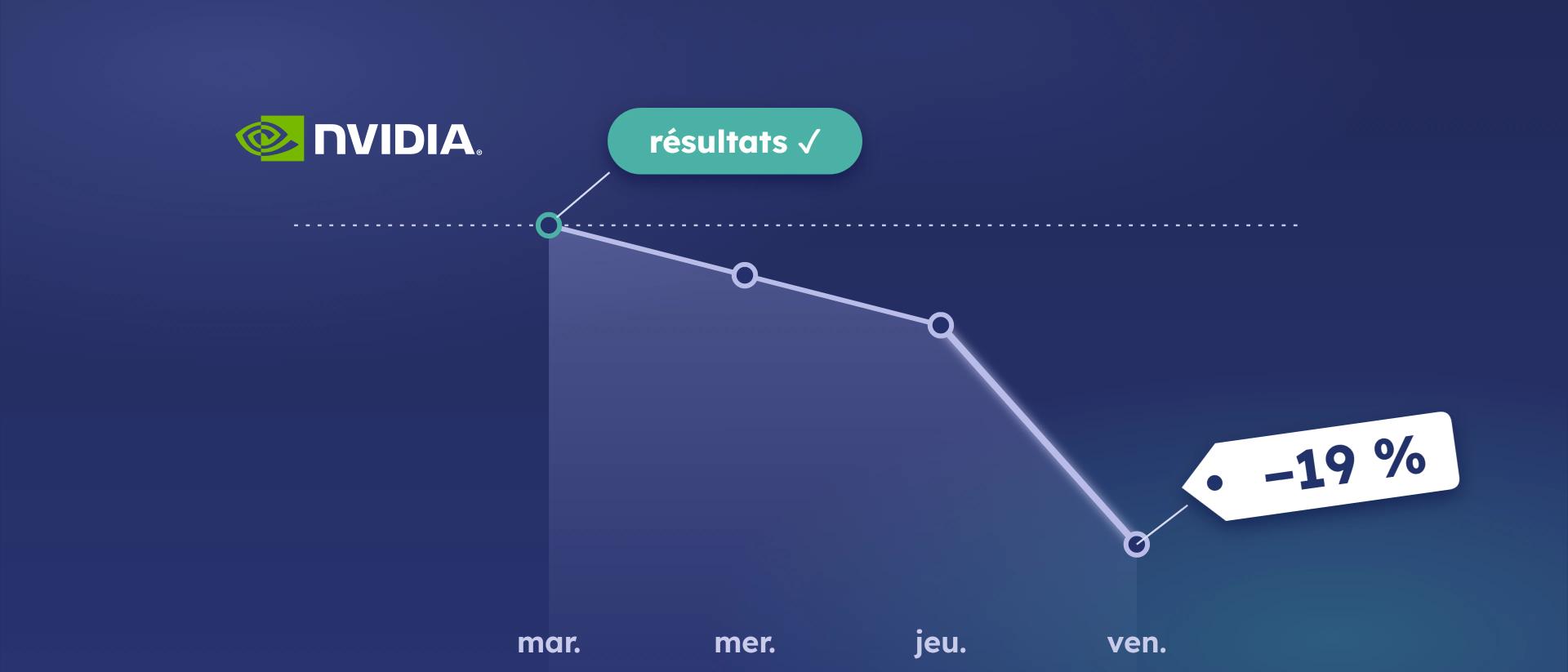
| Tuesday | Quarterly revenue of 115.8 billion dollars, up 103 % year on year and above expectations | results published |
| Wednesday and Thursday | The new management announces it will take a close look at the customers it helps to finance | −6 % |
| Friday | According to Reuters, the SEC investigation reportedly concerns possible accounting problems | −14 % in one session |
| Over the week | Since Tuesday's results | −19 % |
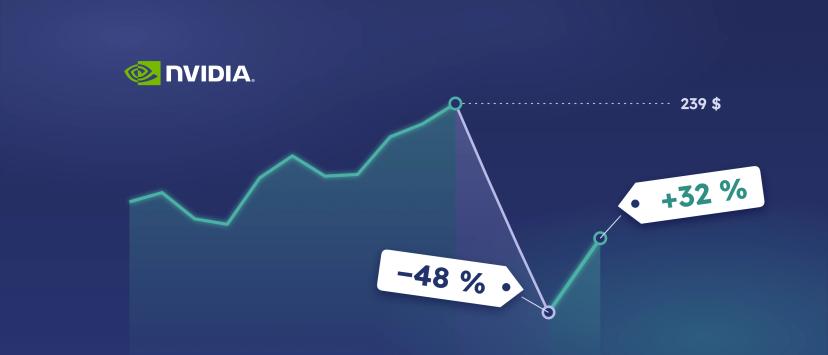
| Since the record | Record close of 6 October 2026 | −48 % |
Nothing has been established in the investigation by the US stock market regulator, the SEC. The market did not wait.
A good report card does not say who filled it in
Tuesday's numbers were excellent. The market did not dispute them. It asked three questions those numbers could not settle.
- Who decides? Nvidia has lost its founder, at its head for 33 years. An interim chief executive is handling the transition. An investor pays for a direction. An interim leaves it on hold.
- Are the accounts reliable? An investigation into the accounts, even unproven, changes the nature of the debate. The discussion is no longer about the quality of the numbers but about their reliability.
- Where do the sales come from? Nvidia helped some customers finance their chip purchases. When a seller finances part of its own demand, growth becomes harder to read. In 2000, Lucent lent to its customers in the same way. Its stock lost 75 % in eleven months.
“The numbers say what a company has earned. Governance and the business model say whether it will keep earning.”
Why could nobody answer this poll correctly?
For the economist Eugene Fama, winner of the 2013 Nobel Prize, prices very quickly incorporate all public information. Tuesday's excellent results were known to everyone: they were already in the price on Wednesday. What moved the price on Friday was information that nobody had on Wednesday.
Forecasting a share price three days ahead therefore means forecasting news that nobody knows. That is impossible. What is possible, on the other hand, is assessing what a company stands to lose if the bad news arrives. And that can be read before the storm, on the flip side of the numbers.
The reflex to keep: three questions before believing a number
- Who produces it and who checks it? A succession plan, a board able to say no, audited accounts.
- Where does it come from? Growth financed by the business is not worth the same as growth financed by the seller.
- What happens if an assumption falls? A customer, a leader, a source of financing.
This holds for Nvidia as much as for the small business you are thinking of taking over or financing.
Where is the handle?
A stock market proverb says you should not try to catch a falling knife. Not because it will necessarily keep falling: nobody knows that. But because you cannot yet see where the handle is. As long as the three questions remain unanswered, caution is not timidity.
On Tuesday, Nvidia had the best numbers in the class. On Friday, it posted its worst week since 2008. In between, none of the numbers published by Nvidia changed. Only their flip side came to light.
The series continues with episode 4: the boss returns.
Meeting your banker or adviser soon?
Ask them how your portfolio would react to a week like this one. Our guide “Avant de signer un placement” (Before you sign an investment, in French) helps you prepare for that meeting: 14 questions to ask and the figures to judge the answers. It is free.
Download the guide
Sources
- Poll. L'envers des chiffres LinkedIn poll of 18 November 2026: 64 votes.
- Nvidia share price. StockAnalysis (16 November 2026); The Motley Fool (17, 19 and 20 November 2026); Seoul Economic Daily (18 November 2026).
- Quarterly results. StockTitan and Seoul Economic Daily, to be confirmed against Nvidia's press release.
- Management statements. Seoul Economic Daily (18 November 2026).
- SEC investigation. Reuters, via Yahoo Finance (21 November 2026).
- Worst week since October 2008. Yahoo Finance (21 November 2026).
- Record of 6 October 2026. ChartRow.
- Lucent. eWeek, “Vendor Financing Backfires” (23 April 2001); Knowledge at Wharton (22 February 2001).
- Market efficiency. E. Fama, “Efficient Capital Markets: A Review of Theory and Empirical Work”, Journal of Finance, 1970.
- Changes. Sagora calculations.
A first version of this text appeared on 22 November 2026 in L'envers des chiffres, Mathias Schmit's newsletter on LinkedIn.
Sagora, editorial line. Educational stance: neither personalised investment advice nor an incentive to invest in any specific asset or product. Prices and information as of 22 November 2026, based on sources deemed reliable at that date and subject to change. Past performance is no guarantee of future results.
 Mathias Schmit5 min read