
Why a positive net profit is not always a good sign
The art of reading between the numbers. The most common pitfalls in interpreting results.
What is a cash flow statement?
The cash flow statement traces the movements of money of a company over a given period. It is divided into four sections, each representing a key aspect of financial management:
- Operating cash flow: reflects the inflows and outflows of cash linked to day-to-day activities such as the sale of goods/services and the payment of suppliers. It is here that the true performance of the company is measured.
- Investing cash flow: corresponds to the flows linked to the purchase or sale of assets, whether tangible (machinery) or intangible (patents, financial assets).
- Financing cash flow: concerns the movements linked to sources of financing, such as bank loans or capital contributions.
- Flows linked to dividend policy: when a company decides to distribute a part of its profit to its shareholders or partners. This is a direct cash outflow that must be well managed to avoid liquidity strains.
The sum of these four components determines the change in cash over a given period, according to the following equation, where CF represents cash flow:

A concrete case to understand better
In 2020, Jane, the niece of Aunt Agathe, decides to create Agathe&Co, a company manufacturing traditional hats inspired by her aunt's style. Let us observe the evolution of its cash flows between 2021 and 2024 to better understand its journey.
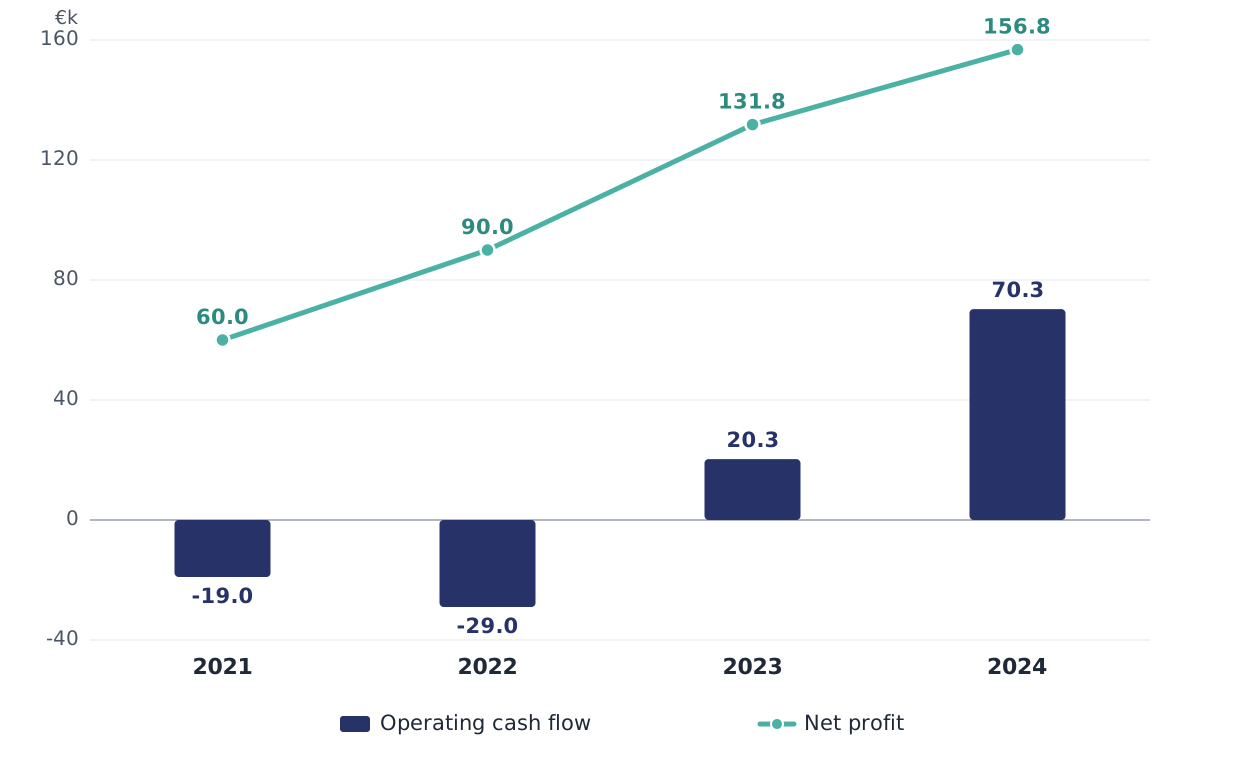
Summary of Agathe&Co's cash flows and net profit, 2021-2024, in €k (negative amounts = cash outflows)
| 2021 | 2022 | 2023 | 2024 | |
|---|---|---|---|---|
| Net profit | 60.0 | 90.0 | 131.8 | 156.8 |
| Operating cash flow | -19.0 | -29.0 | 20.3 | 70.3 |
| Investing cash flow | -1.0 | -1.0 | -1.0 | -101.0 |
| Financing cash flow | 0.0 | 40.0 | 0.0 | 0.0 |
| Change in cash | -20.0 | 10.0 | 19.3 | -30.7 |
A dream too good to be true
The first year goes wonderfully. The “Agathe” hats win over ladies of a certain age. Jane does not worry too much about her finances and asks for the help of her uncle Séraphin (Aunt Agathe's brother), presented as an “expert”. He sets a sales target for 2021, which is met. Jane is jubilant: Agathe & Co posts a net profit of 60,000 €!
A brutal return to reality: Jane loses her head... and almost her shirt!
One evening, while proudly rereading her 2021 accounts, Jane comes across an unfamiliar document: the cash flow statement. She looks at it, and there it is, the cold shower: her operating cash flow is negative, as is her annual change in cash. Without being an expert, Jane understands that something is wrong.
After a little research, she discovers the truth: her business does not generate cash, it consumes it. Worse still, each sale makes her lose money.
The easy reflex: borrowing
Faced with the situation, uncle Séraphin proposes a short-term loan to fill the cash gap. At first, it seems to work: the cash position becomes positive again. But in reality, nothing has changed in the operations. Borrowing to cover operating losses merely delays the problems, by adding repayments and interest to come. It potentially makes the situation worse.
The real problem: payment terms and inventory management
Disappointed by her uncle, Jane consults Aunt Agathe. Thanks to her experience, she finally identifies the true source of the problem: payment terms and the level of inventory.
The elderly customers pay late, often after the help of their grandchildren. Jane, for her part, has to pay her suppliers in cash. On top of that, she maintains a high level of inventory to anticipate seasonal sales. The result: a permanent mismatch between cash inflows and outflows.
As long as Agathe & Co grows on these fragile foundations, its cash position deteriorates. Each sale increases the working capital requirement, and Jane has to advance ever more money to keep the company running.
Hats off, Jane!
After lengthy negotiations, Jane obtains more favourable payment terms from her suppliers. She also considers shortening customer terms through better monitoring and more flexible means of payment. More rigorous inventory management helps her smooth the seasonal peaks.
These adjustments relieve the cash position. In 2023, Agathe & Co finally begins to generate cash and to improve its change in cash.
In 2024, the change becomes negative again, but for a good reason: Jane decides to invest 100,000 € in new equipment and the renovation of her shops. It is an investment for the future, not an uncontrolled cash leak.
Conclusion
Jane's story shows clearly that appearances are deceptive. Despite rising sales and a positive net profit, Agathe & Co's cash situation was critical, a piece of information invisible in the income statement or the balance sheet. Poor management of terms and inventory plunged the company into a vicious circle.
It is like organising a banquet: if you pay for everything in advance, the more guests you have, the more cash you need. If no one reimburses you on time, you end up high and dry.
A positive cash flow is not always a good sign: in 2022, the cash position improved thanks to a loan, without resolving the underlying problems. Conversely, a negative cash position may simply reflect a strategic investment.
In short, reading the accounts is not enough. You have to understand them. Every leader must learn to read between the lines in order to make informed decisions.
Our “Finance for managers” training gives you the tools to do exactly that. Discover it on our training page.
See also: Ziegler bankruptcy: three signals every leader must read, the 2026 case study: how the structure of the balance sheet, the restated EBITDA and the cash flow map foretold the failure in public accounts.
