Build your portfolio with a method
Diversification, risk management and optimal allocation in a context of high volatility.

At a glance
Upcoming sessions
1 scheduled session
Sessions held in FrenchThree days in Brussels or Luxembourg with Mathias Schmit. €2,400 excl. VAT (€2,904 incl. VAT), lunches, breaks, course material, allocation tool and certificate included.
You have investments. Do you know what they do together?
A fund here, a few shares there, a life-insurance policy taken out ten years ago. Each was chosen for good reasons. But the risk you carry is the risk of the whole. And almost nobody measures that whole.
Diversification sometimes disappoints at the worst moment
Ten different lines do not make ten independent risks. When markets fall together, a portfolio you thought cautious can lose far more than expected.
The risk you accept is not the risk you hold
Many portfolios carry a level of risk their owner never chose. It was built by accumulation, not by decision.
Deciding on your own takes a method
Without a reading grid, every conversation with an adviser ends in an act of trust. With a method, it ends in a decision you understand.
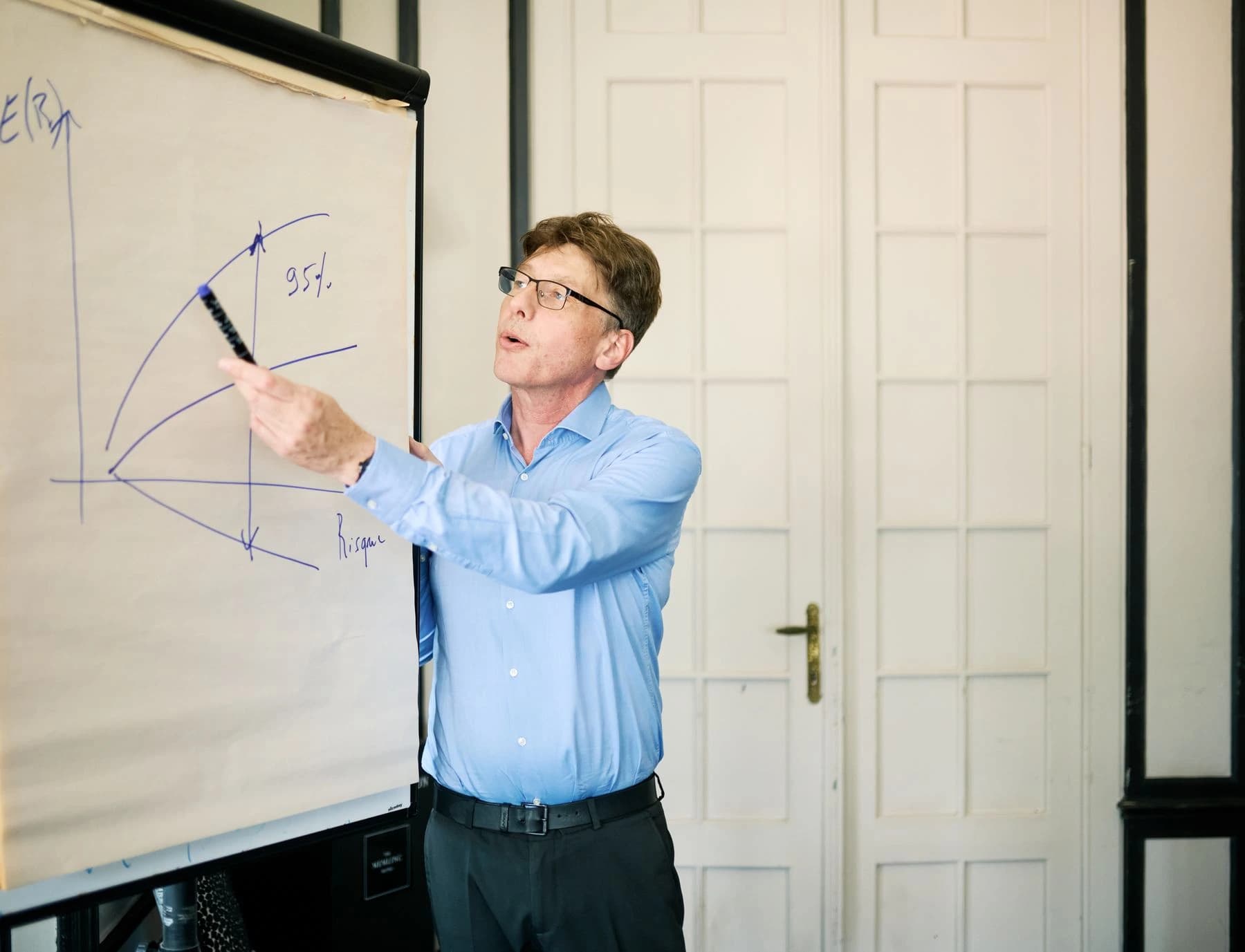
What you will know to ask your adviser
- Time“What happens to me if this investment loses 30% the year I need the money?”
- Risk and expected return“Is this return an arithmetic or a geometric average? Over which period?”
- Diversification“Do my investments all fall at the same time? What is the risk of the whole?”
- Entry, horizon, fees“How much will this product cost me in euros, over its whole life, all fees included?”
What you will learn
See your investments as a whole
A fund, some shares, a life-insurance policy: you learn to measure what they do together, not one by one, and why diversification sometimes disappoints at the worst moment.
Measure the risk, then choose it
How much a portfolio can lose, with what probability, and what level of risk you really accept: simple tools, applied to real cases.
Allocate with a method
Build an allocation that matches your horizon and your profile, with the tool used in the course, and know when to review it.
After the three days, you will be able to
Eight concrete abilities, the ones the course commits to working on with you.
- Diversify your assets according to your risk tolerance
- Avoid cognitive biases in your decisions
- Follow economic and financial news and anticipate its effect on your portfolio
- Regularly assess performance and fees
- Build extreme risks into your strategy
- Detect fraud and avoid financial traps
- Build an investment plan aligned with your goals and your horizon
- Ask your adviser the right questions
Three days, one progression
Each day builds on the previous one. You arrive with your questions; you leave with an allocation you built and the means to review it.
Official 2026 programme. The first two days lay down the method; the third is entirely devoted to a personalised case.
- Day 1Understand
Introduction to portfolio management
Personal financial goals
- Defining your financial goals
- Assessing your risk tolerance
Basic principles of diversification
- Introduction to asset allocation
- Diversification across assets
- Diversification over time
- Day 2Decode
Investment strategies and management practices
Asset classes and their risk
- Equities, bonds and other fixed-income securities
- Commodities and gold, investment funds and real estate, index funds and ETFs
- The relationship between expected return and risk, the importance of horizon and extreme events
- Active or passive management: performance, costs, strengths and limits
Portfolio management practices
- Decoding a key information document (KID) and spotting its pitfalls
- The Madoff case: detecting the signs of a fraud
- The “Wall Street monkey” and market efficiency: why the market cannot be beaten for long
- Day 3Act
Putting it into practice: a complete case
A full day of case studies. On a personalised case, you apply everything covered to build a portfolio.
Building the portfolio
- Investor profile, allocation by asset class and weightings
- Concrete selection of ETFs and funds, analysis of real costs (TER, transactions, tax)
Simulation and action plan
- Testing the portfolio against a rally, a crash, a volatile period
- Analysis of a real KID and detection of warning signs
- Your roadmap and the key questions to ask your adviser
What to bring
A laptop, preferably: the allocation tool is used in class, then at home.
Language
Public sessions are held in French. In-company: French, English or Dutch.
Certificate
A certificate of attendance is issued at the end of the three days.
A method you apply yourself, not an opinion to follow
The course does not tell you what to buy. It teaches you to measure the risk of a set of investments and to allocate it according to your horizon and your profile. You leave with the method and with the tool used in class.
Real cases, not textbook examples
You work on concrete portfolios and compare your reading with the group's. Disagreements are part of the learning.
An allocation tool you keep
The tool used in the course is included in the price. You use it in class, then at home, to build and review your allocation.
Each notion explained when it is needed
No financial background is required. Vocabulary is introduced when it becomes useful, never before.
What the course is not
Neither investment advice, nor a product recommendation, nor a promise of return. Sagora gives no opinion on your investments: it gives you the means to read them.
The course lasts three days. The support continues.
You leave with the allocation tool and the course materials. You also keep access to a library of interactive tools and resources that extend the method, so you can review your allocation when markets move.
The tools you will work with
Each tool isolates one concept from the course and lets you handle it with your own assumptions. They shed light on a decision; they replace neither a full analysis nor personalised advice.
Questionnaire: risk aversion
Open accessTen questions to place your acceptance of risk on a scale from 1 to 7, and to measure the gap between your capacity and your tolerance.
Open the toolThe Efficient Frontier Workshop
Participants onlyNine guided steps on twenty years of real market data: from the best portfolio to sizing it for your horizon, through the crises of 2008 to 2022.
Open the toolAdvanced Portfolio Management Simulator
In preparationThe multi-asset version: your real allocation, recalculated from the correlations, then tested against historical crises.
Discover the toolThe allocation tool used in class is handed to you on day three. It stays yours.
Free reading
The articles and the guide that prepare the course, then keep it alive.
- GuidePortfolio management: the complete guideMarkowitz, strategic versus tactical allocation, volatility and VaR, cognitive errors, black swans and tail risk.
- ArticleA formidable but underrated animal: the Black SwanWhy extreme events matter more than their frequency suggests.
- ArticleTaming risk: a winning bet over the long termWhat the horizon changes in the reading of a market fall.
- ArticleDoes a monkey invest better than you?Burton Malkiel, active management and what the numbers say over time.
- ArticleThe man at the top of the Ponzi pyramidThe Madoff affair, and the signs a key information document should have revealed.
For those who manage their own money, or their company's
No financial background is required. The course is for people who decide, and who want to understand what they decide.
Executives and board members
You allocate your company's surplus cash, or you sit on a board that decides on it.
Self-employed and liberal professions
Your wealth and your business are linked. You want to allocate without depending on a single opinion.
Managers
You have accumulated investments over the years and want, at last, to read them as a whole.
This is not the right course if
You are looking for product recommendations or an opinion on your current investments. Sagora gives neither.
Your trainers
Professors at the Solvay Brussels School (ULB) and corporate finance practitioners. Participants rate Sagora 4.9/5 on Google, across all activities.

- OHOualla Houbayda· il y a 4 mois
Excellente formation en gestion de portefeuille. Je suis arrivé avec plusieurs convictions sur les marchés financiers et je suis reparti avec de meilleures questions, ce qui est probablement le signe d’une formation réussie. Le contenu est solide, mais ce que j’ai particulièrement apprécié, c’est l’approche pédagogique : plutôt que de fournir des réponses toutes faites, Mathias Schmit pousse à la réflexion, remet en question certaines croyances et apporte des outils concrets pour prendre de meilleures décisions en matière d’investissement et de gestion du risque. En tant que data analyste dans le secteur du crédit, j’ai également trouvé de nombreux parallèles applicables à mon activité professionnelle. Merci à Mathias Schmit et à toute l’équipe de Sagora pour ces deux journées riches en apprentissages et en échanges. Je recommande cette formation à toute personne souhaitant développer une compréhension plus rigoureuse de la finance et de l’investissement.
J'ai eu l'occasion de suivre la formation gestion de portefeuille. Ne connaissant rien ou très peu de choses aux finances, je pensais que je serais perdu mais Mathias Schmit a pris le temps de bien de bien expliquer chaque concept et mot de vocabulaire que je ne connaissais pas. Je recommande fortement cette formation !

FAQ
Who is this training for?
Those who manage their own money or their company's: executives, self-employed professionals, managers, liberal professions, board members. No financial background is required: each notion is explained when it is needed.
How much does it cost and what does the price include?
€2,400 excl. VAT, i.e. €2,904 incl. VAT for a private individual. The price includes the three days, lunches and breaks, the course material, the allocation tool used in the course and a certificate. For a Luxembourg company, the course is eligible for INFPC co-financing.
Will I receive advice on my investments?
No. The course teaches a method to measure the risk of a portfolio and allocate it. Sagora recommends no product and gives no opinion on your investments.
In which language is the course given?
Public sessions are held in French. In-company, the course can be given in French, English or Dutch.
Should I bring a computer?
Yes, preferably. The allocation tool used in the course runs on your laptop: you use it in class, then at home to build and review your allocation.
Book your place
Choose your session and leave your details: we come back to you with the practical information.
- Measure the risk of the whole, then allocate it
- Risk management
- Lunches, breaks, course materials and certificate included
This course illustrates portfolio management concepts for educational purposes. It is neither a recommendation, nor financial advice, nor an incentive to invest in any asset or product. Past performance is not a reliable indicator of future results. Your tax and personal situation is not covered: consult a licensed financial or tax adviser before any decision.